Power-to-Weight Ratio Calculator
Calculate acceleration & efficiency of cars, bikes, F1 cars, or cyclists
Formula:
Power-to-Weight Ratio = Power Output ÷ Weight or Mass
Enter power and weight to calculate ratio
Power-to-Weight Ratio Calculator
Our Power-to-Weight Ratio Calculator allows you to instantly measure the efficiency and acceleration potential of any vehicle or human-powered activity. By dividing a vehicle's power output by its weight or mass, you can compare cars, motorbikes, supercars, trains, ships, or even bicycles on a level playing field. Higher power-to-weight ratios indicate faster acceleration and better performance. Use our calculator to explore car power-to-weight, cycling power-to-weight, and even F1 car power-to-weight metrics with ease.
What is Power-to-Weight Ratio?
The Power-to-Weight Ratio (PWR) is a key metric that measures how much power a vehicle or athlete produces per unit of weight. Unlike absolute power, which only tells how strong an engine is, PWR accounts for vehicle mass, enabling fair comparisons across lightweight motorbikes, pickup trucks, supercars, and even spacecraft.
Formula:
Units commonly used:
- hp/lb (horsepower per pound)
- kW/kg (kilowatt per kilogram)
Why It Matters
A car with high horsepower but also heavy weight may accelerate slower than a lighter vehicle with lower horsepower. The power-to-weight ratio accounts for this difference, helping enthusiasts and engineers predict acceleration, efficiency, and overall performance.
For example:
Ford F-series pickup truck: 290 hp, 4,069 lb → 0.071 hp/lb
Ford Fiesta: 89 hp, 2,546 lb → 0.035 hp/lb
Even though the Fiesta has enough power for city driving, the pickup accelerates almost twice as fast in theory.
How to Use the Power-to-Weight Ratio Calculator
Using our Power-to-Weight Ratio Calculator is simple and intuitive:
Step 1: Enter Vehicle or Athlete Power Output
- Cars: horsepower (hp) or kilowatts (kW)
- Cyclists: watts (W)
Step 2: Enter Vehicle Weight or Athlete Mass
Cars, trucks, motorbikes, ships, or bicycles in pounds (lb) or kilograms (kg)
Step 3: Click Calculate
Instantly get your power-to-weight ratio in preferred units
Tip: Use curb weight for cars (vehicle weight without passengers or cargo) to get the most accurate comparison.
Understanding Vehicle Power-to-Weight Ratios
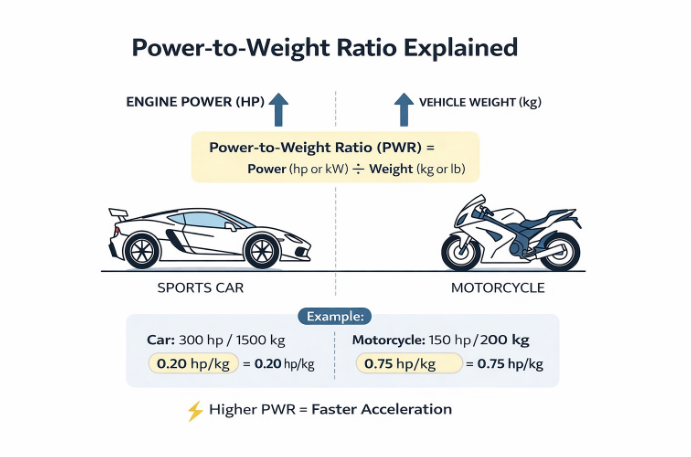
Vehicle Performance Comparison: Different vehicle types have varying power-to-weight ratios affecting their acceleration and efficiency.
Cars and Pickup Trucks
High-performance cars and trucks vary significantly in PWR:
- Supercars: Lightweight with high engine output → high PWR
- Pickup trucks and SUVs: Heavier but powerful → moderate PWR
- Compact cars: Low weight but smaller engines → lower PWR
Motorcycles and Motorbikes
Motorbikes often outperform cars in acceleration despite lower engine power due to extremely low weight, giving them exceptionally high PWR.
Trains, Ships, and Dumper Trucks
While vehicles like trains or ships have massive engines, their enormous weight reduces PWR. Use the calculator to compare different transport modes for theoretical acceleration or efficiency analysis.
Bicycles and Human Power
Cyclists can also calculate their cycling power-to-weight ratio:
- Measure your power output in watts
- Divide by your body weight in kilograms
- Higher PWR indicates better climbing and sprinting performance
Step-by-Step: Calculating Power-to-Weight Ratio
1. Find the Power Output
Check your vehicle's specifications or measure your own output (cyclists) using a power meter.
2. Determine the Weight or Mass
- Cars: curb weight from manual or official sources
- Motorcycles: manufacturer's weight
- Cyclists: body mass in kg
3. Use the Formula
4. Convert Units (if needed)
- 1 hp = 0.746 kW
- 1 lb = 0.4536 kg
5. Compare and Analyze
- Higher PWR → faster acceleration potential
- Lower PWR → slower acceleration but may have other benefits (stability, cargo capacity)
Worked Examples
Example 1: Pickup Truck vs Small Car
Ford F-series pickup: 290 hp, 4,069 lb
Ford Fiesta: 89 hp, 2,546 lb
Observation: Pickup truck has double the PWR → accelerates faster in theory.
Example 2: Cycling Power-to-Weight
Cyclist produces 300 W and weighs 70 kg
Observation: This PWR indicates strong climbing potential.
Example 3: F1 Car
Minimum weight: 798 kg, Power: 772 kW
Observation: Extremely high PWR → unmatched acceleration and speed.
Units and Measurement Guide
| Parameter | Units | Notes |
|---|---|---|
| Power | hp, kW, W | Cars, motorcycles, cycling, rowing |
| Weight / Mass | lb, kg | Use mass for consistency across planets or vehicle types |
| Ratio | hp/lb, kW/kg | Choose consistent units for comparisons |
Experience Tip: Always use the same units when comparing vehicles, e.g., don't mix lb and kg.
Factors Affecting Power-to-Weight Ratio
While PWR is crucial for acceleration prediction, real-world performance also depends on:
- Aerodynamic drag – affects high-speed acceleration
- Rolling resistance – depends on tires and road surface
- Transmission efficiency – power loss in gearboxes
- Vehicle payload – additional weight reduces effective PWR
Power-to-Weight Ratio Across Vehicles
| Vehicle Type | Power-to-Weight Trend | Notes |
|---|---|---|
| Supercars | Very high | Lightweight, high engine output |
| Pickup Trucks | Moderate | Heavyweight, strong engine |
| Motorcycles | High | Lightweight, moderate engine output |
| Trains / Ships | Low | Heavyweight, massive engines |
| Bicycles | Low to Moderate | Human-powered, depends on training |
| Spaceships | Very high | Light and high thrust-to-weight ratio in orbit |
Power-to-Weight Ratio Calculator for Cycling and Sports
- Cycling: PWR determines climbing and sprinting efficiency
- Rowing & Weightlifting: Helps assess muscular power relative to body mass
- Running: Measure running efficiency in watts per kg
Expert Tip:Competitive cyclists often aim for > 5 W/kg in short sprints.
FAQs
1. How to calculate power-to-weight ratio?
Use the formula:
Choose consistent units (hp/lb or kW/kg).
2. Is a higher power-to-weight ratio better?
Yes, a higher PWR indicates better acceleration and speed potential. However, stability and vehicle control should also be considered.
3. How to calculate car power-to-weight ratio?
- Find the vehicle's peak power (hp or kW)
- Determine curb weight (lb or kg)
- Divide power by weight to get PWR
4. How to calculate power-to-weight ratio for motorcycles?
- Obtain engine power
- Check motorcycle weight
- Divide power by weight → higher ratio = faster acceleration
5. How to calculate cycling power-to-weight ratio?
- Measure watts via a power meter
- Divide by body weight in kg
- Use PWR to assess climbing/sprinting efficiency
6. How to calculate power-to-weight ratio per ton?
Convert weight into tons (1 ton = 1,000 kg or 2,204 lb), then divide power by total tons.
Experience-Based Tips
Track PWR Changes
Add weight (passengers/cargo) to see real-world impact on acceleration.
Compare Across Vehicles
Use PWR instead of raw horsepower to evaluate performance fairly.
Optimize Cycling Performance
Train to increase watts while reducing body weight for better PWR.
Supercars vs Motorbikes
Motorbikes may outperform in acceleration despite lower engine power due to extreme lightness.
Conclusion
The Power-to-Weight Ratio Calculator is an essential tool for comparing vehicle performance across different categories. Whether you're evaluating cars, motorcycles, F1 cars, or even your own cycling performance, understanding PWR helps you make informed decisions about acceleration potential and efficiency. Use this calculator to gain insights into how power and weight interact to determine real-world performance.
Similar Calculators
Explore these related calculation tools